
Turn Business Intent into Governed
Enterprise Products
Upload a brief, a document, or a Jira backlog — and get structured requirements, user stories, and test cases in hours. Every output traces back to your original intent.
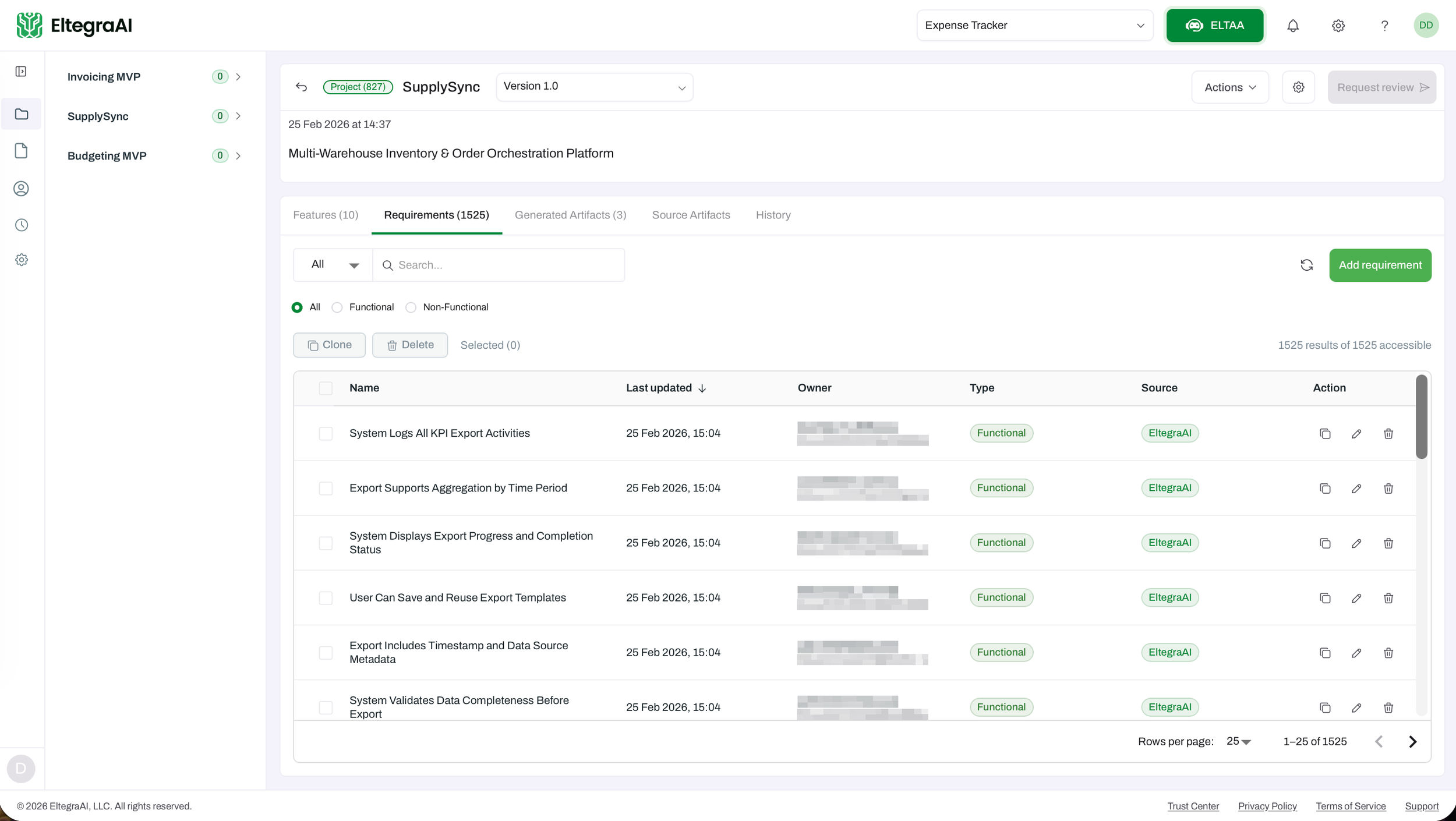
One brief in. 10 features · 142 user stories · 1,525 requirements · 1,400 test cases out.
Weeks, not months, from intent to governed product.
Why product delivery breaks down before a line of code
is written
Business intent gets scattered across Word docs, Jira tickets, SME notebooks, and stakeholder emails. By the time development starts, the original intent has been filtered through five handoffs and nobody fully agrees on what's being built.
The result: rework, scope creep, and products that don't match what the business actually needed.
EltegraAI eliminates the handoff problem. It reads your existing documentation — requirements drafts, specs, interview notes, compliance docs, Jira tickets — and builds a structured knowledge graph of your intent. The knowledge graph is a connected map of your business entities, decisions, and requirements — structured so every output traces back to a source, and every change propagates to what depends on it. Every requirement, user story, and test case it generates is grounded in that graph, not generated from scratch.
From intent to Jira-ready artifacts in five steps
01
Create a product discovery project
Define the scope of what you're building: a new feature, a full product, a migration, or a compliance initiative. Clear scope produces clearer outputs.
02
Upload your documents and knowledge
Import requirements drafts, technical specs, architecture diagrams, business process docs, SME interview notes, and compliance documents. You can also import directly from Jira. The wider the variety of inputs, the richer the knowledge graph.
03
EltegraAI runs intelligent document analysis
The platform extracts business entities, functional requirements, decision logic, compliance obligations, and domain terminology — and connects them in a patent-pending knowledge graph. This is not summarization. It's structured extraction with full traceability.
04
Review and refine the extracted knowledge
Validate the requirements and relationships EltegraAI identified. Spot-check early — corrections at this stage are cheap; downstream rework is expensive.
05
Generate delivery artifacts and push to Jira
Export structured user stories with acceptance criteria directly to your Jira workspace. Generate a full BRD. Ask follow-up questions in plain language: "Which requirements are impacted by this change?" or "What are the open compliance items?"
What you'll have at the end of your first project
Structured knowledge graph — A connected map of your product domain: entities, requirements, decisions, and their relationships
Extracted requirements — Functional and non-functional requirements pulled from your actual documentation, not invented
User stories with acceptance criteria — Delivery-ready, Jira-compatible, traceable to source
Full BRD — Business Requirements Document generated from your knowledge graph
Compliance audit trail — Compliance and governance items flagged and documented
Plain-language Q&A — Ask questions about your own product in natural language and get grounded answers
Works with the documentation you already have
You don't need to clean up or restructure your existing documentation first. EltegraAI reads what your team actually produces.
Product requirements documents (PRDs) and feature briefs
Functional and technical specifications
Architecture and process diagrams
Business process documentation
SME and stakeholder interview notes
Compliance, governance, and policy documents
Jira tickets (import directly from your workspace)
Generic AI tools generate requirements from their training data. They don't know your business, your compliance context, or your existing systems.
EltegraAI grounds every output in your analyzed enterprise artifacts. The patent-pending knowledge graph ensures that what it generates is traceable, accurate, and specific to your situation — not a generic template dressed up as your product.
Every requirement links back to a source document. Every user story links back to a requirement. Every test case links back to a user story.
When something changes, you know exactly what it impacts.
Why not just prompt an LLM?

99.9%+ accuracy — vs. 60–75%
for generic LLM tools

Full traceability — brief → requirement →
user story → test case

Patent-pending knowledge graph —
US 63/848,151
Built for teams that need to move fast without losing control
Net-new product team
You have a business problem and a rough brief. No legacy system to worry about — just the need to go from conversation to verified specs before development starts.
Enterprise with scattered documentation
Your product knowledge lives across Confluence pages, old Word docs, Jira, and SME brains. You need it unified and structured before the next sprint.
Regulated industry team
You're in a regulated industry (finance, healthcare, insurance) and your requirements need to be traceable and compliant from day one, not bolted on at the end.
From first brief to governed product — in weeks, not months.
Book a 30-minute demo and see EltegraAI turn your documentation into a structured delivery plan.