
By Fima Katz, CEO, EltegraAI
Every few months the industry holds its breath for the next model. A new release lands, the benchmarks jump, and the question in every boardroom is the same: is this the one that finally transforms our business?
I have spent my career building, selling and watching technology waves reshape companies. My view is that the next major breakthrough in enterprise AI will not be a smarter model. It will be an architecture: reasoning models, persistent enterprise knowledge and autonomous agents working as one system.
The model is becoming the engine. What enterprises are missing is the rest of the car.
Intelligence is no longer the bottleneck
Today’s reasoning models are already capable enough for most business work. When they fail inside an enterprise, it is rarely because they are not smart enough. They fail for three structural reasons:
They don’t know your business. The rules, exceptions and decades of decisions buried in your systems are not in any training data. A model can reason brilliantly about a problem it only half understands.
They don’t remember. Every session starts from zero. What one team learns on Monday is gone by Tuesday, and nothing compounds across projects.
They can’t prove their work. A plausible answer is not an auditable one. In regulated industries, “the model said so” is not a control.
A model ten times more capable still has all three problems. More intelligence applied to missing context just produces more confident guesses.
The architecture that changes the equation
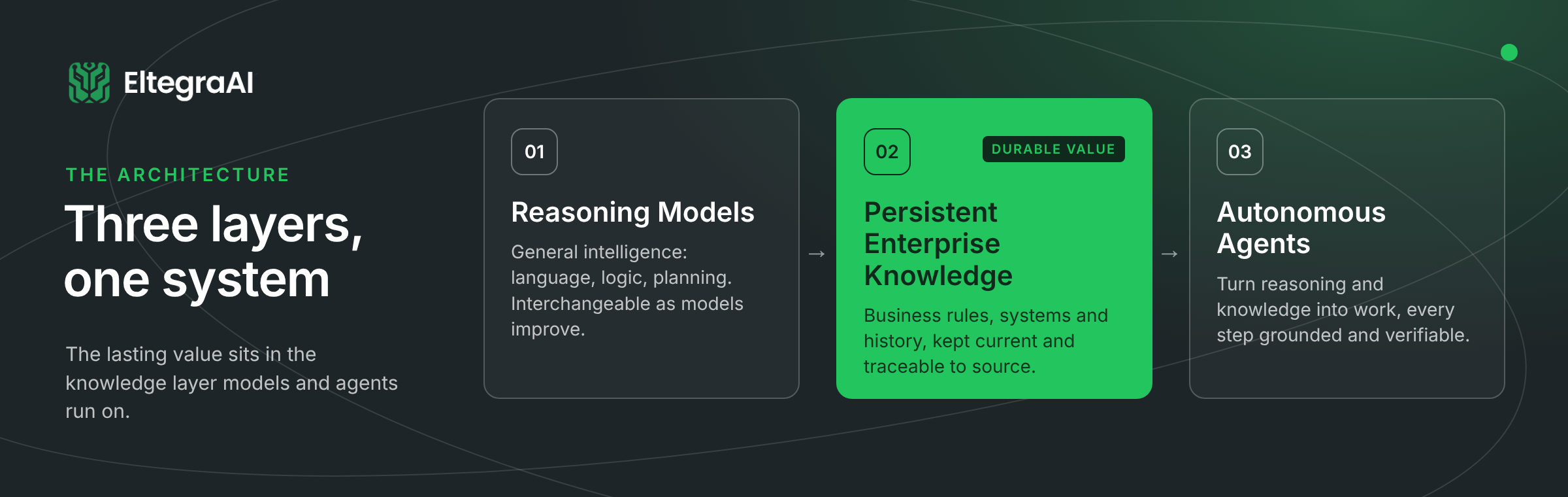
The breakthrough I expect is a system with three layers, each doing what it does best:
Reasoning models supply general intelligence: language, logic, planning.
Persistent enterprise knowledge supplies what a model can never have on its own: your business rules, your systems, their history and how they connect, kept current and traceable to the source.
Autonomous agents turn reasoning and knowledge into work: generating requirements, modernizing systems, running processes, with every step grounded in that knowledge.
We have seen this pattern before. The breakthrough of the database era was not faster disks. It was a persistent, governed layer of truth that every application could rely on. Once that layer existed, applications multiplied on top of it.
Enterprise AI is at the same point. Models are the engine. The knowledge layer is the missing system of record.
The test: will the next model make it obsolete?
There is a fair objection. AI researcher Rich Sutton called it “the bitter lesson”: general methods that ride on more compute eventually beat hand-built cleverness. Models have repeatedly absorbed the tooling built around them. Prompt tricks, retrieval workarounds and agent frameworks that patched weak reasoning became unnecessary as models improved.
So every enterprise AI investment should face one question: will a better model make this redundant? The answer splits cleanly in two.
Scaffolding that compensates for model weakness gets absorbed. If it exists because today’s model is not quite good enough, tomorrow’s model will replace it.
Infrastructure that supplies what models structurally lack survives. Your proprietary knowledge, its provenance, governance and accountability, and deterministic answers where the business or the regulator requires them. No amount of training on public data creates these.
The durable architecture is built from the second kind. Reasoning models and agents will keep getting better and cheaper on their own schedule. The lasting value sits in the knowledge layer they run on.
What could prove me wrong
I hold this view with conviction, not certainty. Three things could change it:
Models with vast context and built-in memory. If a model can hold an entire enterprise in context and remember it reliably, part of the external knowledge layer becomes unnecessary. Even then, provenance and governance remain.
Agents that stay unreliable. Small errors compound over long, multi-step tasks. If that persists, autonomy will arrive more slowly than the demos suggest.
Knowledge that goes stale. A knowledge layer is only as good as its freshness. If it drifts from the real systems, trust collapses and people route around it.
I also doubt it will feel like a single moment. More likely it will look like the ERP era: a few years of architecture quietly settling into a standard, until it is simply how enterprises run.
What leaders should do now
If this is right, the most important AI decision in front of an enterprise is not which model to standardize on. Models will keep changing, and switching between them will keep getting easier. The decisions that last are about knowledge:
Capture what your systems actually do. The business intent locked inside legacy code and scattered documents is your most valuable AI asset, and it is disappearing as the people who understand it retire.
Make that knowledge persistent and traceable. Build it once, keep it current, and link every answer back to its source.
Judge every AI investment by the bitter-lesson test. Fund what supplies what models lack. Be wary of what only patches what they can’t yet do.
Let agents earn autonomy. Start where their work can be verified against your knowledge, and widen the scope as trust is proven.
This conviction is why we built EltegraAI around a persistent enterprise knowledge graph rather than around any single model. But the argument stands on its own, whatever tools you choose.
The companies that win the next wave will not be the ones with access to the smartest model. Everyone will have that. They will be the ones whose AI actually knows their business.
Where do you see the bottleneck in your organization: model capability, or knowledge? I’d like to hear from people working on this.
Fima Katz is the CEO of EltegraAI. Book a demo to see how EltegraAI turns legacy systems into a persistent, traceable knowledge layer for AI.